Showing posts with label Xi Jinping. Show all posts

Friday, 17 October 2014

How the Umbrella Revolution of Hong Kong is becoming a pain in the a** for China?


A sovereign state is defined as the one which has complete supremacy over its geographical territory and the laws made by it. The context I am looking for is that literally both the conditions are missing in the case of Hong Kong, which justifies Chinese anecdote of naming Hong Kong as the Special Administrative Region (SAR) of China.

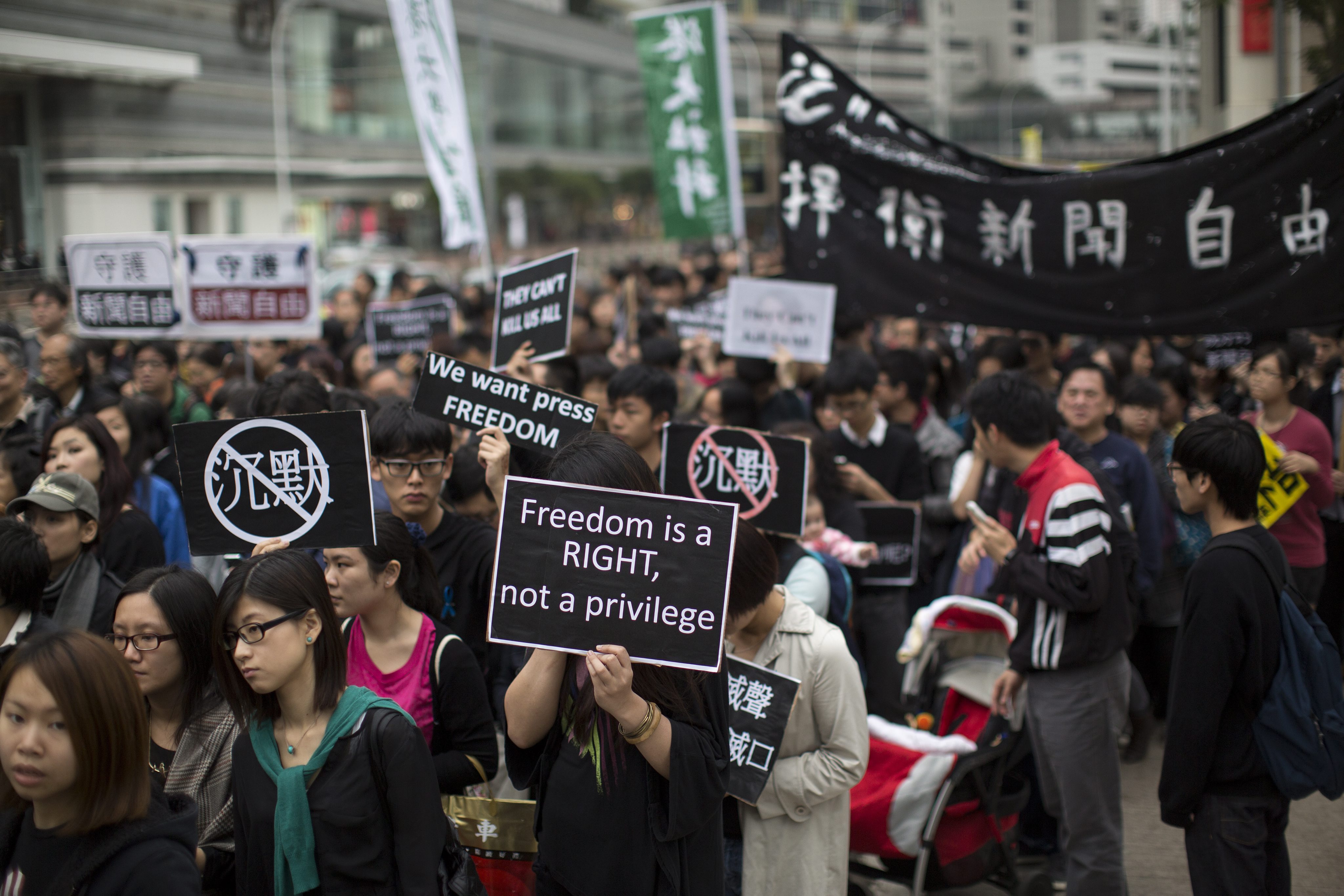
Britain gave reins of Hong Kong back to China in 1997, during which the Beijing gave certain assurances, under what was termed as ‘One country two systems’, Hong Kong was allowed to keep its common law system and assured of greater rights than those prevalent in mainland China, as China would not interfere for at least 50 years in the affairs of Hong Kong except for the decision of the leader of the region (Chief Executive). Residents of Hong Kong hoped that by 2017, they would be able to elect their own Chief Executive to run Hong Kong. China says that there will be no open nominations for the job and only those cleared by the Communist Party would be allowed to contest. This has fueled demonstrations that have turned up to be the biggest public protests in Hong Kong since Chinese rule, also known as the ‘Umbrella Revolution’ (Thousands have deployed umbrellas to protect themselves from the tear gas attack of the police. It had lead some of them to call it ‘umbrella revolution’).

The tension in Hong Kong is after the revision of the recent Beijing’s stand contradicting the original 1997 position (adoption of universal suffrage). The process now has been reduced merely to the vetting of the candidates for the post of Chief Executive of Hong Kong (SAR). In the Legislative Council of Hong Kong, more than half are nominated members, and only handful are directly elected by the constituents of Hong Kong.

Extent of autonomy that Hong Kong enjoys –
Political control is vested with the Communist Party of China. Administrative, financial, economic, legislative, social autonomy has been protected under the basic law or what people call the semi constitution of Hong Kong. The crucial point is the election of Chief Executive of Hong Kong and the political regulations guiding his firm control by the Beijing.

Why Hong Kong wants more autonomy?
This is a revision of the promises that Deng Xiaoping made in the 1980s and following its inscription in the basic law of Hong Kong SAR. The original promise that Deng Xiaoping made when he started negotiating with the British under Margaret Thatcher was that ‘One country two systems’ would include ‘universal suffrage’ for the people of Hong Kong and the deadline for that was given as 2017. Recently the National People’s Congress, which is the Chinese Parliament, has passed a resolution stating that the 2017 elections will be controlled by nominations and there will be a vetting process of the candidate of Chief Executive of Hong Kong SAR.

Therefore, there is a kind of frustration in Hong Kong people which is generated with a lot of factors –
  •  Growing social inequality – Hong Kong has crony capitalism much like Russia (Hong Kong topped ‘The Economist’ list of Crony Capitalist Index, beating Russia), where huge wealth is dominating and the people of Hong Kong are not having basic economic rights. For example – Buying even a small house is a dream for majority of the Hong Kong people.
  • Successive migration from mainland China (Hong Kong people find them inferior).
  • Faith in the Government is at all time low (after the Chief Executive’s stand on Hong Kong’s autonomy).
This is in the nature of democratization to demand not just the political reforms but breaking up the structures of domination like we have seen in Taiwan (Reduction of Kuomitang Party’s economic control) and all the new countries that came up post Soviet disintegration, especially Eastern Europe.

Major groups taking the lead –
Hong Kong Students Federation, Young school students, Group of democrats (Occupy Central with peace and love) are some of the independent groups yearning for a common cause of greater transparency and autonomy in the internal affairs of Hong Kong. There are differences between these groups and the movement is largely ‘leaderless’ and there is no one point of target that can be said about the protests in contrast to the ‘Sunflower protest’ that took place in Taiwan few months ago. The younger protesters have pushed the matters to the forefront and they have sort of forestalled the old style of democrats like Martin Lee and party (although he is also active). The new style has been adopted because the tear gas and pepper sprays were used against the protesters which forced the ordinary Hong Kong people to come at the protest site. The new protesters may compromise on certain cases while continuing their protests to achieve the ultimate goal of real autonomy in the near future.

How China justifies this movement as illegal and unconstitutional?
Beijing is ready to follow the letters of the ‘basic law’ of Hong Kong, but not the spirit of it. Beijing proclaims that the demands of the protesters did not accord with what the basic law or the semi constitution (Hong Kong’s constitution) stipulates. The demand of universal suffrage has been accepted by China but the protesters are asking for the transparency and rationality in the selection of candidates via the process of direct elections, which is neither the part of basic law/constitution nor what the leaders have said anytime during negotiations with the British.

History of Hong Kong Protests –
In 2003, Hong Kong protested against Article 23 which was a security related law that impinged on their freedom and pressured the government to shelve it.

In 2012, they protested against the education plan, which made certain text books compulsory that censored out Tiananmen Square like incidents completely and it was seen as the communist brainwashing.

People’s Republic of China has not declined the promise of ‘Universal Suffrage’ and they have not taken a hard line despite the nature of the government in Beijing. Protesters are asking for the resignation of Chief Executive Leung Chun-ying that could happen later but not immediately as it would mean a loss of face and de-legitimatize the process of elected officials.

When Hong Kong was handed over to China, it was seen by the British as a gateway to China on economic grounds but contemporarily the relevance of Hong Kong has declined with the emergence of Shanghai as the new economic hub. This had given a certain level of angst to the ordinary people of Hong Kong that their specialness seems to be eroding and the interests of the international community especially the British is declining with regards to Hong Kong's cause.

Why majority of HONG KONGERS oppose these demonstrations?
According to a poll, 46% of Hong Kong people do not support the pro-democracy movement, while only 31% supported the same. 47% of the youngsters (Below 24 yrs of age), 21% of people in the age group of 40-59 years support the cause too. This all depends on how the protesters, majorly the youngsters identify the core issue which is the demand of ‘direct elections’. The young protesters are influenced by the Occupy Wall Street, Tehrir Square, Jasmine Revolution (start of Arab Spring), Sunflower movement etc.

Irony is that the business community also does not support the pro-democracy movements as they feel that democracy would not be suitable for the elite class who share a good reputation with Beijing on administrative affairs of Hong Kong. President Xi Jinping met Hong Kong tycoons on September 26th to discuss the Hong Kong state of affairs.

How China will deal with these protests?
China has backed the decision of the Hong Kong police to use tear gas and pepper sprays against the protesters which show a shadow of China’s aggressive stand during the Tiananmen Square incident of 1989. One is the factor of Chinese nationalism and the emphasis of Premier Li Keqiang and President Xi Jinping’s policy of ‘One country’ rather than ‘Two systems’. Before becoming the President, Xi Jinping was the chairman of the leading small group on Hong Kong and Macau affairs, so as Vice President he has handled Hong Kong and Macau for five years and he is quite aware of the situations of these two SARs. Through Hong Kong, China will give a strong message to the West to back off from their internal matters (as Hong Kong has been the key spying port of West throughout the Hong Kong’s history) with the policy of iron hand and velvet glove.

China, rather the world community would never desire for any instability in Hong Kong because of it being a ‘tax haven’ i.e. a financial holiday spot for oligarchs of the West as well as China. They would never want to disturb their hard earned money by risking their investments in Hong Kong through violent revolutions, so it is absurd to believe that CIA is directly funding 500,000 protesters on the roads of Hong Kong through its various NGOs.

Worries of China –
China is worried that the Hong Kong protests will embolden the protests in the mainland like in Xinjiang (Uighurs community as Rebbiya Kadeer criticized Hong Kong situation and asked Uighurs to buckle up for the future war of independence) and Tibet. Also the future of Taiwan’s annexation also depends upon how China handles the Hong Kong situation with the idea of ‘One country and Two systems’ deal originally proposed by Taiwan in 1978. Taiwan’s proposal actually materialized with Hong Kong through the negotiations with British but China’s actual target was Taiwan for the reunification of China and Taiwan. But now Taiwan is not interested in the idea proposed by them in 1978 as they have nothing much to gain but have substantial things to lose if they reunify with China. Taiwan’s President Ma Ying-Jeou is also critical of the idea of reunification now especially after the response of China to the recent Hong Kong situation.

Future of China –
Amid growing bourgeoisie in China (150 million out of 1.4 billion population), they are demanding larger share of power structure. Communist Party introduced the elections at the village level even though the communist party’s base is at the county level (Tehsil level). China has to pacify the growing middle class and the voices of dissent through US President Franklin Roosevelt’s policy – “Speak softly and carry a big stick.”

The best thing about future is its nature of uncertainty. Therefore we have to see if Communist Party of China is willing to share power with the people or would it repeat the horrifying episodes of Tiananmen Square like incidents in all the conspiring parts like Xinjiang, Tibet and Inner Mongolia.

Thursday, 25 September 2014

Happy Birthday Narendra Modi. With love - Xi Jinping


When we talk about India and China, the first thing that is highlighted in our minds is that these two giants contribute 2/5th to the total population of the world. Therefore, a Chinese President’s visit to India (after 8 years) bewitched global media.

For China, India is a part of its South Asian policy which itself is a part of its peripheral diplomacy. But for India, the visit embarked the biggest objective of including China in Indian economy to achieve the developmental goals. As per World Bank estimates, India requires $110 billion investment in infrastructure to come at par with Middle Income countries or we can say that India requires $1.6 trillion investment in infrastructure over the next 10 years to prove his metal in the geopolitical arena.

To make the visit a success, Indian Prime Minister Narendra Modi made personal gestures to the Chinese President by breaking various protocols (the same gesture he received from Japanese PM Shinzo Abe during his Japan visit). India knows that Xi Jinping will be in power at least for the next 8 years and he is very powerful in China and almost projects himself as not only the President but also as the ‘Chairman’ of China, so it was important to lure him through such gestures. Unfortunately, the border incursions by the PLA of China breed suspicion and diverted the purpose and objective of the visit and brought security issues back to the forefront. Prime Minister of India raised the border issue with China for the first time ‘publicly’ and categorized it as the foundation of overall Sino-India relationship. In return, Chinese President used an encouraging formulation with regards to the border agreements in the joint statement by calling to settle the boundary disputes at the earliest. It is an unusual formulation with respect to a Chinese President, irrespective of the actual delivery of the promises.

Absurd claims by the Chinese consulate of Mumbai, of Xi Jinping planning to invest $100 billion in India (when its total investments worldwide is $80 billion) and thereby Indian media going berserk over the issue of reduction in the contemplated investments disappointed Indian masses. There is a huge difference between investment and supply contracts, therefore only MoU were signed and China will only realize the objective of investing $20 billion in India over the next five years. Moreover, Chinese investment in India will come in the form of ‘Investor Funds’ (usually 5-10 year) which will create production capacity in India and not in the form of ‘Sovereign Funds’ (usually 30-40 years) which creates infrastructure. But it’s reasonable because sovereign funds take time to negotiate.

Two issues drive China’s foreign policy in Asia Pacific region –
  1.       The very serious economic difficulties being concealed by China which is weakening the Chinese economy week by week.
  2.     Chinese isolation in Western Pacific region. One after the another frictions from his neighbors, and over arching it is the US’s strategy of a rebalance, which is on hold but not gone till now. China has a nightmare that it will solidify when India will join US as an ally in the region.


But China also contemplates that India is a very independent player with a sense of strategic autonomy and India will never be a part of any camp. This is soothing for Chinese ears.

Despite being his most ambitious project, China didn’t talk about the Maritime Silk Road project except at a very low key and not at all in the official address to the media because it knows that India is not willing to buy it, but on the BCIM corridor (Bangladesh-China-India-Myanmar) issue, China has got a positive reply from India. Chinese MSR project is actually a repost to the American rebalance and it is busy to garner support from wherever it can. It got enough support in the Indian Ocean but Western Pacific region didn’t give him enough leverage. Also, India has also come up with MSR’s counter, with a project named MAUSAM/ MAWSIM (in Arabic) – Maritime Routes and Cultural Landscapes. It aims to reconnect and re-establish communication between countries of the Indian Ocean and reinvigorate the traditional sea links and cultural landscapes.

China will upgrade Indian Railways, supply us bullet trains, set up Industrial Parks, especially in Maharashtra and Gujarat. But there is a hurdle in the trade balance too, because Chinese banks are very reticent to lend to Indian Corporate houses (Chinese investments in India currently lies at $415 million) except to blue chip companies like Reliance, and there is no direction from Govt Of China to them to look at the Indian market as a serious investment destination. Also, the sectors in which India has strengths, like pharmaceutical industry, China is not giving market access to India till today. But in a joint statement, China has agreed to look up to the demands of opening up their domestic markets for Indian Pharmaceutical companies, IT industry, Agricultural products.

India seeks Civil Nuclear Cooperation with China but if it is established then India would be left with no grounds to oppose the same cooperation of China-Pakistan, except that India has a NSG waiver and Pakistan doesn’t. Also there is no sufficient need and evidence for India to go for a civil nuclear partnership with China, but if it needs to expand its resource allocation base, India could eye towards South Korea in this matter.

Broadly, the recent bilateral visit of Chinese President was accompanied with mixed signals from China where on one side it used positive signals to enlarge futuristic cooperation of our bilateral relationship, whereas on the other side, the security issues were dominating the negotiation tables too. Since 1988, India has a strategy to carry on the relationship with both China and Pakistan on two parallel tracks – One is the dispute resolution track for which the framework was set up in 2003 and the other is economic cooperation and development.


Friday, 28 June 2013

What’s cooking in The White House, Beijing & The Kremlin ?


By the grace of the almighty or by the grace of the Eastern powers, the NSA’s whistleblower Edward Snowden is still alive and very much safe in the Moscow. Although, it is the most widely discussed topic for the news aficionados these days, but the whistleblower himself is hiding from country to country just to ensure that his consistent extradition requests made by the United States cannot be executed by a country.

In a pre-planned move, he flew from the United States to the Hong Kong (on 20th May), in which he proclaims to have ‘a strong tradition of free speech’ and made some serious allegations against the PRISM project (that costs about $20 million/year) of the National Security Agency of the US. The revelations moved like oxygen in the atmosphere of the intelligence agencies of various rival as well as adherent countries of the United States. Print as well as broadcasting media went berserk over the allegations made by the whistleblower on the United States as well as on the ‘General Communications Headquarters of Britain’. Accordingly, the PRISM project has produced over 77,000 reports and accounts for 14.3% of the normal intelligence reports (1/7th of total intelligence reports). This project is also a major contributor to Mr. Obama’s daily briefing. Data from various tech giants such as Microsoft, Yahoo, Facebook, Skype etc were taken by the NSA officials by intruding straight into their servers, without the consent from these tech companies for incurring the private as well as professional information of the residents as well as non residents of the United States (as per Snowden’s reports). Even the telecom operator of the US - ‘Verizon’ was intruded to obtain the voice calls of the suspects as well as of the innocent peoples, compromising the privacy of the individuals on the name of security.

Let’s not get into the debate of who’s right or who’s wrong, or if it is satisfactory to compromise privacy in the name of security. But let’s take a brief look at what Snowden revealed in the Hong Kong (SAR). His reports were not confined to the United States intrusion in citizen’s privacy, but he also accused the NSA for hacking up the systems of China and other enemy countries of the US, possibly Russia. This gave China an excuse to fire bullet on Snowden’s shoulders and to proclaim that although China is accused of mass hacking or cyber intrusions but he himself is a prey of mass cyber hacking. Probably, Chinese Government Officials were consistently in touch with Mr. Snowden in the Hong Kong (SAR) after his arrival, that’s why even Hong Kong’s treaty with the United States for enemy extradition didn't help the US to arrest it’s so called ‘traitor’ when he flew from the Hong Kong to the Moscow on the Q.T.


‘The Kremlin’ is still considered to have a ‘Cold War’ with ‘The White House’ which is testified after some recent cold shoulder decisions by Russian President Vladimir Putin such as political and military support to Syrian President Bashar-al-Assad over “US & Company’s” support to Syrian rebels. In the case of Edward Snowden also, an official of Russian Human Rights Commission Mikhail Fedotov reported that,’ the case of asylum for Mr. Edward Snowden can be considered by the President if Mr. Snowden files such a request but only on human rights ground’. This came after Snowden’s repeated attempts to pacify countries like Iceland and Ecuador to consider his asylum request with the help of Jullian Assange (WikiLeaks founder). Ecuador had a trade pact with US that were to be renewed by the US Senate in the coming few months, but yesterday Ecuador broke the trade pact with US to thwart ‘blackmail’ over Snowden’s asylum. Iceland’s businessman and a supporter of WikiLeaks has offered an airplane to bring Snowden from the Moscow, but no official confirmation from Govt. of Iceland has been arrived yet. Therefore, it is upon ‘The Kremlin’ to take a decision, whether it wants to make a stand against the US by offering asylum to the whistleblower, which is nothing new for it since the Cuban missile crisis in 1961 or to be like China which is not keen to take a straight step against his long time enemy/newly found friend (after Xi Jinping & Obama’s positive meeting in the US).

The ball is in Russian court as Snowden is currently in Moscow. The coming few days will be crucial for Snowden as well as for the Eastern powers to dilute US hegemony in the current political scenario worldwide.