Showing posts with label Prime Minister. Show all posts

Sunday, 25 September 2016

Decrypting the fortunes of theocracy

Post-Uri terrorist attack, the media glares were focused on what the most powerful man of India, Prime Minister Narendra Modi would say on Pakistan. Albeit, he chose a political rally to convey his displeasure to “Terroristan” (An analogy shared by noted author Chetan Bhagat for Pakistan), but the message was disseminated proportionately to satisfy the thirst of hawks on both sides of ‘Line of Control’, the self-proclaimed liberals, rationality bearers, non-ideological citizens as well as international stakeholders.

Amidst the conspicuous glow of tensions surrounding the decades old adversaries, a larger question remains unanswered. “Why do the nations born with a religious premise are far more unstable and volatile than the nations born with secularism as their core value?”
To understand this fundamental question, we shall take a look at what exactly we mean by a ‘nation’?

In The Ethnic Origins of Nations (1986), Anthony Smith presents the ‘primordialist view’ which states that the nations are historically embedded; they are rooted in a common cultural heritage and language that may long predate the achievement of statehood or even the national independence.

Does this cultural heritage necessarily mean religious homogeneity? How far has it been successful? It has been observed in post-colonial era that the nations which derive the legitimacy of their authority on religious foundation often found themselves trapped into the quagmire of a deep moral conflict.

The diagnosis of the problem does not require vigorous crystal ball gazing but a narrow understanding of history. Various reasons can be attributed to the issue, such as: -

Firstly, as the foundation of the State is based on the spirit of intolerance, hence the breeding of sleazy animosity and fissures within the society is easy with no diverse ideological and philosophical apparatus to neutralize such threats.

Secondly, these inbuilt theocratic impulses offer resistance to change within the society, which in turn renders intellectual development, modernity, innovation and spiritual growth ineffective.

Thirdly, it is easy to radicalize and manipulate the population because of lack of alternative source of opinions. This further ignites the fire of distrust and disharmony in the homogeneous society.

Fourthly, the debate regarding material economic progress is impounded by the forces of irrationality and religious orthodoxy claiming monopoly over decision making. Moreover, the State in such societies is mostly subservient to the dictates of the latter pressure groups, pushing the ‘Base and Superstructure’ theory of Karl Marx into obsoleteness.

Fifthly, the spirit of homogeneity of society makes it difficult to adapt the opportunities of globalization and liberalization which propagate the heterogeneous structures of society in an interconnected world. The results of such disconnect is evident from the emerging violence in the developed world, allegedly carried out by the alienated communities.

Sixth, as the religious sphere cycles through the phases of downfall and precipitation due to the inevitable circling of the clock, the State too gets deformed because of lack of availability of alternative forces of unification which are either unrepresented or underdeveloped in such societies.

Seventh, due to the prevalence of radical nobility, the fundamental rights of liberty, equality and fraternity are impaired with irrational theocratic discourses, which ultimately paralyses the dialectical progress that germinates diversity of opinions and synthesis of such opinions in consistently changing social dynamics. The acceptance of diversity of opinion broadens intellectual horizon and facilitates conflict resolution through multiple fashions. But its absence due to the homogeneous structure of society consequently submerges such States under the tides of anarchy.

Last, but not the least, the dominance of religious orthodoxy also impairs the accountability of the State towards the populace and any question of impropriety is settled with the deliberations of maintaining religious status-quo under the garb of threat to the religion. Hence, it proves that democracy and theocracy are non-complementary and the existence of such political associations could be a farce.

The forces of partition ignited the idea of States based on religion. On one side, the belligerence which established Pakistan celebrated the idea of ‘Islamic Republicanism’. The other side, albeit pressured by the hawks of religious supremacy, adopted for a sovereign, socialist, secular and democratic republic guided by the ideas of liberty, equality and fraternity to secure social, economic and political justice for all irrespective of belief, faith and worship.

As the Prime Minister today spoke to the belligerent hawks of Pakistan, “If you want to fight a war, we accept the challenge. Let us fight against poverty, unemployment, undernourishment, injustice, griminess and diseases. Let us see who wins the war first.”

Friday, 6 May 2016

India throws ultra dynamic diplomatic card on the Chinese table


India issued visa to multiple Chinese dissidents like Dolkun Isa, Lu Jinguha, Ray Wong to attend the 'World Uyghur Congress' in Dharamsala with the Tibetan exiled leader 'HH Dalai Lama' among others. The controversy surrounding the sudden ultra offensive stance by India against China in terms of reversing the policy on internal non-interference evoked nationalist muscularities. But the delight was short-lived with India cancelling the issued visas on technical grounds. This on-and-off relationship evoked strong criticism from the puerile as well as nationalist ranks. Indian media as usual started reading between the lines from the writings on the wall to assimilate their little understanding of the issue by playing rhetorical series to invoke ultra nationalism. But does it really mean that India itself co-opted a 'planned embarrassment'?
Prudential diplomacy requires understanding the weather patterns before the clouds start to rain. The identification of the characteristics of the clouds on the basis of amount of moisture it contains, capability to create 'thunderstorms' and understanding the 'white-wool like structure' requires abandonment of foolish consistencies. India judiciously applied the 'paradox of value' of Adam Smith in political terms by trading the opportunity of China's veto to Masood Azhar's banishment (being water in Smith's value paradox) with the border agreement with China (being diamond in Smith's value paradox). But how? India cunningly created panic among the Chinese policy makers by signalling a policy shift to accommodate pro-democracy and Uyghur activists from the volatile Xinjiang province under its umbrella. But the sweetness of the deal lies in the fact that they were not allowed to touch the soil, thereby keeping the Chinese to anticipate the possible ramifications of India's future contingency plans like this. Like virginity, a card once played loses its value. Hence, the subtlety dictates keeping the cards closed and keep the foe guessing.
As ends justify the means, the result of such diplomatic overtures can be judged victorious if we happen to secure some legitimate long-term interests vis-à-vis China. A long pending approval to negotiate border agreement, trade disputes and strategic interests should have been secured on the basis of reciprocity of such a generous gesture from our side. The controversy came amidst the visit of our National Security Advisor 'KC Ajit Doval', who is also the plenipotentiary of the Prime Minister on the bilateral negotiations on the border agreement. It is not hard to understand who, how and why dictated such an act of a 'planned embarrassment' and pushed the Ministry of External Affairs in fire-fighting, probably after securing overdue long term interests. A short-term 'perceived embarrassment' may sometimes become inevitable to secure long-term gains. But a cautious approach advises India to keep the Chinese dissidents in close confidence and exploit the opportunities available through them optimistically.Dynamics of diplomacy are surely hard to understand and the usual writings on the wall may not secure legitimate interests due to the ever-changing potentialities of the adversaries and the allies alike. Albert Einstein says 'insanity' is doing one thing again and again and expecting different results every time. Therefore, to quote Mr Doval, “India has a mentality to punch below its weight. We should not punch below our weight or above our weight, but improve our weight and punch proportionately.”

Friday, 11 March 2016

Are we reaping the maximum return on investment of the subscription called 'Prime Minister Narendra Modi'?

https://41.media.tumblr.com/1b854b19e239d8137b9d7287ffa4a2eb/tumblr_nxuy73732p1sv80eno1_500.jpg
If we run a cost-benefit analysis to calculate the returns India should get with a facility adopted in May 2014, known as ‘Prime Minister Narendra Modi’, we would realize that we are failing to explore the full potential of the service. We should realize that we have subscribed for this service till 2019 amidst the downturns - in economy, material well-being of citizens and above all, the goodwill of India as a whole.
In purely economic terms, the cost paid for the subscription of a service should be less than the returns to be exploited from it, to earn a reputed share of profit. India paid a huge cost for a big time since last decade and earned a service named ‘Prime Minister Narendra Modi’ in return in 2014. But it is to be calculated that are we cooperating enough with the service provider so as to reap the maximum returns out of him? For instance, if you call a service provider for your old, rusted ‘Air Conditioner’ in the wee months of a scorching summer season, what do you consider to be beneficial for you – Providing him adequate water supply, required cooperation, help in diagnosis of the issues that corroded your old air conditioner, worthy suggestions for quick solutions OR would you deny him the water supply to clean it, hide the way to the electricity terminal to test the repaired product, outright rejection of his suggestion to shift the air conditioner from current installation to another one. Consider the above instance, which proposition do you think would yield maximum possible results? Non-cooperation to preserve short-term gains OR cooperation even at the cost of little trouble in short term conceiving long term gains out of an otherwise dead asset?
The motive behind throwing this analogy for the citizens is to cogitate if we have given adequate support to our ‘service provider’ and if we have done enough to ‘block’ the covetous and envious people from opposition disguised to be our false sympathizers, actually desiring to destruct our decades old ‘precious’ asset through the earlier rust. They want to accelerate the process of corrosion, otherwise decelerated by our ‘new’ service provider. If we let them succeed, who is to be blamed for it? We the subscribers, who despite of getting an experienced and splendid service provider failed to block the attempts to derail his work OR the service provider himself who tried real hard with all his powers in hand to kick-start our old asset OR the envious opposition people? Whomsoever would get the blame in the end, but the truth would stand out in the open that INDIA failed to reap maximum benefits out of the service called ‘Prime Minister Narendra Modi’ (2014-2019).
Amidst all the pessimism, the subscription time of 3 years is left, we could either continue our silent non-cooperation OR we can block the envious non-sympathizers from derailing the process of development to ensure a bright future of our motherland.
Extract each calorific energy of him by questioning him on productive issues, report diagnosis and possible solutions, ensure transparent and timely actions and cooperate in swallowing essential 'bitter pills'. Only then we deserve to be presented with the reports to analyze his competence to rule this nation.

Friday, 30 January 2015

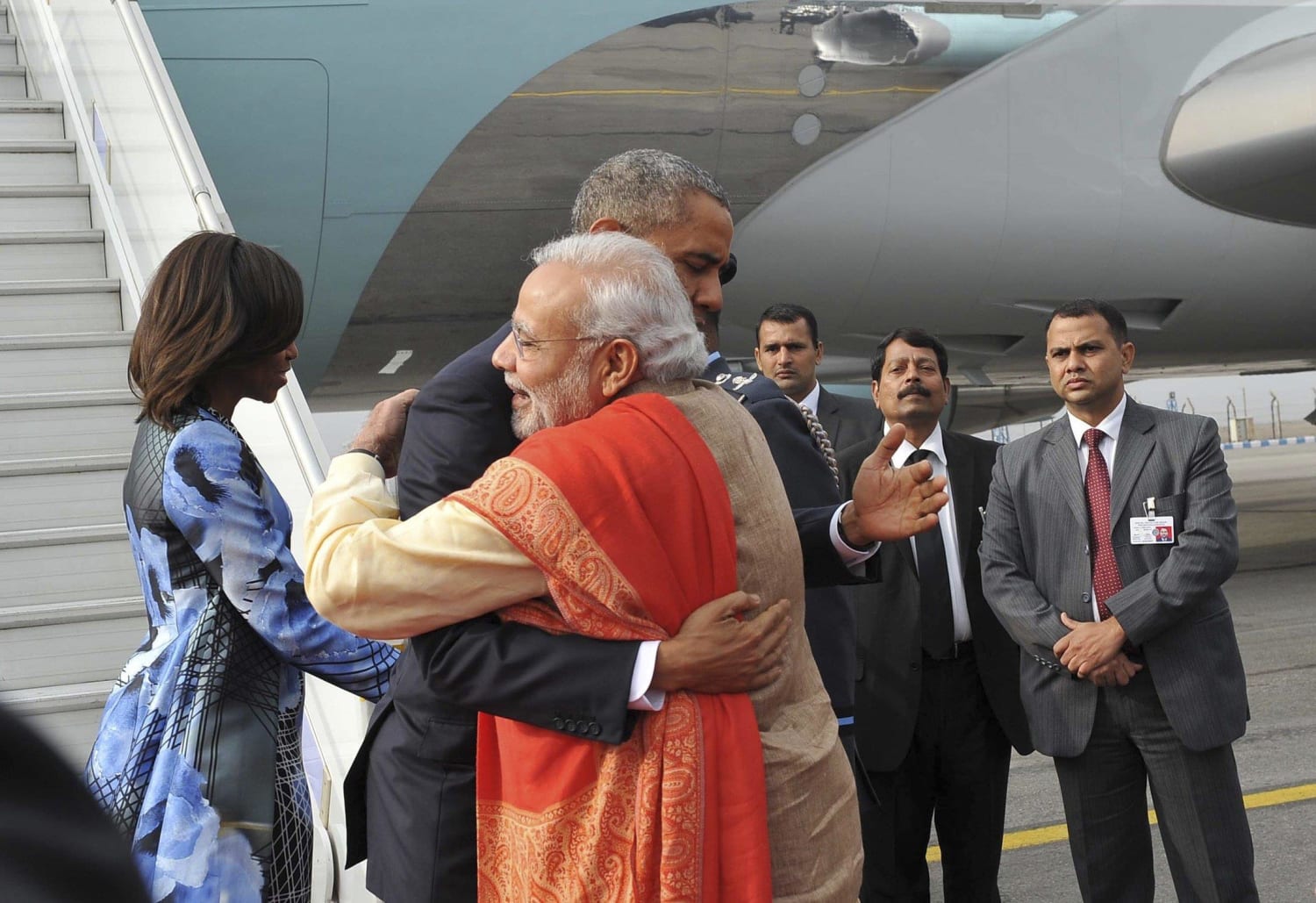
When POTUS meets LOTUS

"baahon ke darmiyaan, do pyaar mil rahe hain"

On this 66th Republic Day of India, a special friend and a prospective partner President Obama was the Chief Guest of the occasion. The whole ‘hullabaloo’ in the strategic relationship between India and US was vigorously circumscribed by this visit with breaking away of many old traditional protocols set up by the elitists of the two nations. The invitation scene was much more dramatic as it got sealed within 19 hours (literally) when the news broke out that the Russians have decided to sell Mi-35 helicopters to Pakistan (in November).

From all the ‘Twitter Bromance’ between Prime Minister Modi and President Obama - bro-hugs between them – ‘Chai Pe Charcha’ at Hyderabad House – Victory of Dress Designer of PM Modi over Michelle Obama’s designer – early departure of Prez Obama to a country where human rights are of supreme importance and where women are more loved and respected (Saudi Arabia), all clouded the ‘Breaking News’ column of the Indian as well as International Media (Barring Fox News for obvious reasons). But what were the substantial gains out of this high profile, orange candy visit?

If we go by media coverage (both Indian as well as International) the two leaders merely talked about Nuclear Deal only (for 3 full days) but that is something wrong in reality. Even though the logjams over the ‘Nuclear Liability Law’ have been cleared through the much needed political push from both the sides, but still it is commercially unviable for American companies to actually incorporate their nuclear plants in India. But the fact remains, that the bone has been ejected out of the throat, ironically by the surgeons who injected it earlier. Although full details of the deal are yet to come but precisely a pool of four insurance companies has been made that will indemnify Rs 750 crores in the case of an accident and the rest amount (said to be Rs 750 crores, total being Rs 1,500 crores) will be allocated by the Government of India. But it should not be forgotten that under the ‘Liability of Nuclear Damages Act, 2010’ (Section 7), there was a provision of creation of ‘Insurance Pool’ but that pool was of value of Rs 1,500 crores and any damage beyond that would be indemnified by the Government of India through another pool called ‘Nuclear Liability Fund’. There was a special ‘National Tracking Demand of Nuclear Material’ by the US officials that if they are providing us the nuclear material then they would like to keep a track on it ‘for lifetime’ to which India responded by saying that we are already following the provisions of IAEA so there is no particular need of this provision. Now, US seem to have agreed over this suggestion too. Skeptics say that it is immaterial if US has agreed over it because the Americans would keep tracking the same through their ‘own ways’, may be a reference to ‘software tracking’.

On the defence and strategic cooperation front, we managed to secure DTTI (Defence Technology and Trade Initiative). Actually it was the current Defence Secretary of US, Ashton Carter (pro-Israel and India) who prepared the framework of DTTI earlier, and as now he has been assigned to the high office, he would energetically push forward the same for its early implementation. Although in India, we have a perennial suspicion over assurance of defence supplies from US (as evident from the fact that we wasted the 10 year Defence Partnership Agreement from 2005-2015 without working on DTTI), but now the co-production model would overcome the reticence on India’s part. DTTI would help in enlarging our defence capacity, building our defence industry and will add up to the manufacturing sector of India.  Four modest projects have started, two aircraft carriers would be produced over the period of next 10-15 years in India and successively we would be helped in the manufacturing of jet engines for which India was eyeing towards a reliable partner since a long time. Still the fact remains that co-development of defence technology cannot have a sustained foundation unless there is a convergence of strategic and security perspectives because they build the much needed mutual trust. It doesn’t mean that we don’t have one with the US, as there are similar interests in Asia Pacific as well as in the Indian Ocean region.

On the issue of ‘Climate Change’ to which US is so much active these days that it points finger at ‘climate change’ for everything, even if it means a slight change in the skin colour of President Obama, the Prime Minister of India has rejected the notion that India would ever succumb to pressure from any country or a person over any issue (a reference to US-China bogus deal on climate change) but he didn’t forget to mention that climate change is a pressure itself for which India is doing enough at its own end by using renewable and clean sources of energy (nuclear energy, solar energy, wind energy etc). The onus also lies on America to give us IPR free ‘Green Technology’ to increase our proportion of clean energy in our total energy consumption.

When talks went on the ‘Totalization agreement’, US unambiguously said it only does ‘Totalization Agreements’ with OECD countries but India has pushed forward one on the pretext of having the same with Finland and Sweden because both these nations have recognized schemes like ULIP, PPF etc as ‘Social Security Schemes of India’ contrary to the belief of US which denies to recognize that India has social security schemes. Taxes for the ‘Social Security Schemes’ by Indians living in US (6-8.5%) contribute to about $ 3 billion (as per Chief Economic Advisor – Arvind Subramaniam) to US exchequer, even though most of the Indians do not take the benefits due to several reasons. Therefore, India was more willing to reach an agreement over this during this visit.

For the trade and business matters, there were usual assurances by India on ease of doing business, transparency and stability in policy, relaxation of taxation procedures as well as clamping down on retrospective taxation provisions but there was nothing US specific to which Prez Obama pledged $4 billion investment in renewable energy sector of India. He also didn’t forget to mention that India’s exports to US amount to merely 2% of total imports of US and imports by India amount to merely 1% of total US exports, which was certainly soothing for Chinese ears.

Chinese media (especially Global Times) started pinching Chinese Government over the ‘Special vision statement of strategic cooperation in Asia-Pacific and Indian Ocean region’ between India and US, clearly seen as a containment of China measure. It contains four major components – Freedom of navigation including in the South China Sea, building up of the trilateral dialogue along with Japan and identify trilateral projects (new component), avoiding the use of force in settling territorial disputes and a marriage of convenience between India’s Act East policy and the ‘Rebalancing policy’ of US towards whole Asia.

All in all, this was a successful visit as it cleared most of the broader issues except immigration reforms of US (but it is justified now because Democrats are in minority in Congress so it is not possible) and the transfer of technology in the field of science. But as the critics can never be satisfied, even if the two leaders would have smooched each other on live TV, so there is nothing wrong in moving at a prudent pace.

PS - That is how PM Modi actually welcomed Prez Obama. #SoSorry
https://www.youtube.com/watch?v=xnhxRcSH1zs

Thursday, 9 October 2014

'Kem Chho' Mr Prime Minister? - President Obama


One of the most anticipated visits of Prime Minister Narendra Modi was to the United States that ended up early this month. Anticipated one because this is the same US which denied him a visa earlier in 2005 for the alleged violation of human rights/minority rights for his 'alleged' role in 2002 Godhra riots. Now, the times have changed, the visa seeker CM Modi has turned out to be PM Modi in the run up to the world's biggest democratic elections ever.

Although Obama Administration was pre-occupied with internal as well as external issues, but they showed apparent interest in building new ties with India. It is because, the world has understood that PM Modi is a forceful personality, decisive, capable to take hard decisions and also business friendly. All these templates made it clear that Americans were very much looking forward to engage with the new powerful Prime Minister of India.

Prime Minister Narendra Modi went there with a tag of political as well as economic salesman, carrying brand India in his baggage to the far off the North-West Atlantic Ocean. Narendra Modi's departure statement carried 1/3rd mention to the meeting with President Obama, signaling other significant issues that would come on the table of negotiations during the bilateral talks.

The departure statement can be construed as the marking of start of Indian Renaissance era, and less of geostrategic angle to it. The visit of the United States was perfectly synchronized with the September 25th launch of 'Make In India' campaign to communicate that India is not merely a market now, and it is the upcoming hub of manufacturing. He further advocated his 'Make In India' vision to the US Business community by enlightening the importance of investing in India with the vision of 3D's - Democracy, Demography and Demand. In the strategic point of view, his statement clarified that India wants to be a bridge between the West and the East and at no circumstances, India would be pressurized to make a choice between the two. His article in the Wall Street Journal after his immediate arrival, made it clear that we are interested to re-energize the bilateral relation which was in a state of stagnation from the past few years. In the end, the efforts concluded with the relationship coming on track of incremental improvement with few small steps and big leaps.

The driving force behind the visit were two important issues -
  • First was the act of rebalancing visit of Chinese President in the same month of September.
  • Secondly, PM Modi is the new 'Head of the State', so there were a lot of contemplations regarding him in the West.
It was intended to be a transformational visit from the Indian side, and not from the US's side as Assistant Secretary of State for South Asia Nisha Biswal made it clear that US is not looking for a transformative action in this visit. But the Indian expectations of transformational visit didn't materialize in reality. To look at the visit in the context of deliverables, there was nothing substantial on the papers, but off the track, it spread the gospel that Modi era has begun and India will have effective governance, rule of law and predictability in the market, that the businessmen expect.

Liberals complained that major irritants were not discussed in detail like Solar equipment export to India on which US moved to WTO, IPR issues, Federal Aviation Authority of US downgrading Aviation Safety Ranking of India (DGCA), Federal Drug Administration clamping down on Indian pharmaceutical companies like Ranbaxy, Doha Round of Conference on Food subsidies (WTO FTA), impasse over the wrinkled Civil Nuclear Liability Act etc. Liberals also complained that India kept on adding task forces and working groups in this high profile visit too, which was not necessary as it could have been done at the bureaucratic level too and there was no need for a Head of the State visit for it.

Although, the visit should not be envisioned in the context of financial deliverables, but also to the intent that has been imparted through the momentum of forwarding the bilateral relationship. Both countries extended the Defense Cooperation Agreement for another 10 years, which was about to expire in 2015. US agreed for a comprehensive investment strategy in Indian infrastructure, especially building up 3 new smart cities at Ajmer, Allahabad and Vizag.

Joint statement by the head of states of both nations called for an agreement in near future that they will try to resolve the differences over the Civil Nuclear Liability law and America originated nuclear reactors will produce nuclear power in energy hungry India soon. Prime Minsiter Modi also made it clear that he is not against the Free Trade Agreement but he also wants to push his case in the WTO. President Obama looked towards increasing the bilateral trade from current $100 billion to $500 billion in the times to come.

Addressing the business community in US, PM Modi said, " I'm going to reform the policies and processes to make it easy to do business in India." These were the two major issues of US investors as they saw 'Policies' = Never meant to be reformed and 'Processes' = Bureaucratic red tapism. He also said, " You people can come to make money in India, we don't expect you to come and not make money, businesses are born to make money." Such a statement ran like a music to the ears of US investors as it was an out of the line statement by an Indian PM ever, indicating the pro-business image of the head of the Government of India.  But US investments would be guided by the time when Indian industry would start investing seriously and begins to place faith manifestly in Indian market.

The biggest task for which Prime Minister Narendra Modi took out a lot of time is to unite the Indo-American community and build it up as a powerful group to use them in the case of need for lobbying for national interest of India. It was inspired by the Jewish diaspora and their activities that gives legitimacy even to the illegitimate actions of Israel by the US.

Finally, the relationship has been reset at the highest level and the sourness of despair that was prevalent in the bilateral attitude has been neutralized up to some extent. Next few years, especially 2016, when the new President would be sworn in the US, would guide the future course of action. Till then, both India and US do realize the fact that they need each other at least for the next two decades to balance the strategic equations crossing each other's path and destiny.

Saturday, 27 September 2014

An Invitation to 'Make In India'


Sharing the debut piece by our Honourable Prime Minister @narendramodi in Wall Street Journal giving a call to "Make In India", to boost manufacturing that is currently contributing merely 15% to our GDP.

An Invitation to 'Make in India'
With 800 million people under age 35, we are a nation ready for rapid, responsible economic development.


Indian Space Research Organization (ISRO) scientists and engineers cheer after India's Mars orbiter successfully entered the red planet's orbit.

There is a high tide of hope for change in India. This May, across India's immense diversity, 1.25 billion people spoke unequivocally for political stability, good governance and rapid development. India has a government with a majority in the Lok Sabha, our lower house of parliament, for the first time in 30 years. A young nation with 800 million people under age 35, India is brimming with optimism and confidence. The young people's energy, enthusiasm and enterprise are India's greatest strength. Unleashing those attributes is my government's biggest mission.

We will pursue this mission by eliminating unnecessary laws and regulations, making bureaucratic processes easier and shorter, and ensuring that our government is more transparent, responsive and accountable. It has been said that doing the thing right is as important as doing the right thing.


We will create world-class infrastructure that India badly needs to accelerate growth and meet people's basic needs. We will make our cities and towns habitable, sustainable and smart; and we will make our villages the new engines of economic transformation. "Make in India" is our commitment—and an invitation to all—to turn India into a new global manufacturing hub. We will do what it takes to make it a reality.

We ran our election campaign on the promise of inclusive development. To me, that means many things: skills education, and opportunity; safety, dignity and rights for those in every section of our society, especially women; a bank account for every Indian; affordable health care within everyone's reach; sanitation for all by 2019; a roof over every head by 2022; electricity for every household; and connectivity to every village. In addressing these daunting challenges, I draw confidence from countless extraordinary stories of ordinary Indians that I have seen through decades of travel across India.

I also strongly believe in the possibilities of technology and innovation to transform governance, empower people, provide affordable solutions for societal challenges and reach people in ways that were unimaginable not so long ago. The number of cell phones in India has gone up from about 40 million to more than 900 million in a decade; our country is already the second-largest market for smart phones, with sales growing ever faster. When I think of the growth in computing power and storage capacity and its miniaturization that the world has witnessed over the past two decades, I am confident that this can be replicated in renewable energy. With solar and wind power, thousands of Indian villages will be able to get access quickly to reliable, affordable and clean energy, without waiting for large, faraway conventional power plants to be built.

For this reason, India's journey to prosperity can be a more sustainable and environmentally sensitive one than the path followed by countries that came of age in earlier eras. This is a journey of our choice, rooted in our tradition that worships nature's bounties.

India will pursue its dreams in partnership with our international friends. History tells us that India's natural instinct is to be open to the world. India will be open and friendly—for business, ideas, research, innovations and travel. In the coming months, you will feel the difference even before you begin your travel to India.

The United States is our natural global partner. India and the U.S. embody the enduring and universal relevance of their shared values. The thriving Indian-American community in the U.S. is a metaphor for the potential of our partnership, and for the possibilities of an environment that nurtures enterprise and rewards hard work. Our strengths in information technology are especially important for leadership in the digital age. The partnership between our businesses takes place in the comfort and certainty of similar political systems and shared commitment to rule of law. In education, innovation, and science and technology, the U.S continues to inspire India.

India and the U.S. have a fundamental stake in each other's success—for the sake of our values and our many shared interests. That is also the imperative of our partnership. And it will be of great value in advancing peace, security and stability in the Asia and Pacific regions; in the unfinished and urgent task of combating terrorism and extremism; and in securing our seas, cyber space and outer space, all of which now have a profound influence on our daily lives.
The complementary strengths of India and the U.S. can be used for inclusive and broad-based global development to transform lives across the world. Because our countries' values and interests are aligned, though our circumstances are different, we are in a unique position to become a bridge to a more integrated and cooperative world. With sensitivity to each other's point of view and the confidence of our friendship, we can contribute to more concerted international efforts to meet the pressing global challenges of our times.

This is a moment of flux in the global order. I am confident in the destiny of our two nations, because democracy is the greatest source of renewal and, with the right conditions, offers the best opportunity for the human spirit to flourish.

Mr. Modi is prime minister of India.

Thursday, 25 September 2014

Happy Birthday Narendra Modi. With love - Xi Jinping


When we talk about India and China, the first thing that is highlighted in our minds is that these two giants contribute 2/5th to the total population of the world. Therefore, a Chinese President’s visit to India (after 8 years) bewitched global media.

For China, India is a part of its South Asian policy which itself is a part of its peripheral diplomacy. But for India, the visit embarked the biggest objective of including China in Indian economy to achieve the developmental goals. As per World Bank estimates, India requires $110 billion investment in infrastructure to come at par with Middle Income countries or we can say that India requires $1.6 trillion investment in infrastructure over the next 10 years to prove his metal in the geopolitical arena.

To make the visit a success, Indian Prime Minister Narendra Modi made personal gestures to the Chinese President by breaking various protocols (the same gesture he received from Japanese PM Shinzo Abe during his Japan visit). India knows that Xi Jinping will be in power at least for the next 8 years and he is very powerful in China and almost projects himself as not only the President but also as the ‘Chairman’ of China, so it was important to lure him through such gestures. Unfortunately, the border incursions by the PLA of China breed suspicion and diverted the purpose and objective of the visit and brought security issues back to the forefront. Prime Minister of India raised the border issue with China for the first time ‘publicly’ and categorized it as the foundation of overall Sino-India relationship. In return, Chinese President used an encouraging formulation with regards to the border agreements in the joint statement by calling to settle the boundary disputes at the earliest. It is an unusual formulation with respect to a Chinese President, irrespective of the actual delivery of the promises.

Absurd claims by the Chinese consulate of Mumbai, of Xi Jinping planning to invest $100 billion in India (when its total investments worldwide is $80 billion) and thereby Indian media going berserk over the issue of reduction in the contemplated investments disappointed Indian masses. There is a huge difference between investment and supply contracts, therefore only MoU were signed and China will only realize the objective of investing $20 billion in India over the next five years. Moreover, Chinese investment in India will come in the form of ‘Investor Funds’ (usually 5-10 year) which will create production capacity in India and not in the form of ‘Sovereign Funds’ (usually 30-40 years) which creates infrastructure. But it’s reasonable because sovereign funds take time to negotiate.

Two issues drive China’s foreign policy in Asia Pacific region –
  1.       The very serious economic difficulties being concealed by China which is weakening the Chinese economy week by week.
  2.     Chinese isolation in Western Pacific region. One after the another frictions from his neighbors, and over arching it is the US’s strategy of a rebalance, which is on hold but not gone till now. China has a nightmare that it will solidify when India will join US as an ally in the region.


But China also contemplates that India is a very independent player with a sense of strategic autonomy and India will never be a part of any camp. This is soothing for Chinese ears.

Despite being his most ambitious project, China didn’t talk about the Maritime Silk Road project except at a very low key and not at all in the official address to the media because it knows that India is not willing to buy it, but on the BCIM corridor (Bangladesh-China-India-Myanmar) issue, China has got a positive reply from India. Chinese MSR project is actually a repost to the American rebalance and it is busy to garner support from wherever it can. It got enough support in the Indian Ocean but Western Pacific region didn’t give him enough leverage. Also, India has also come up with MSR’s counter, with a project named MAUSAM/ MAWSIM (in Arabic) – Maritime Routes and Cultural Landscapes. It aims to reconnect and re-establish communication between countries of the Indian Ocean and reinvigorate the traditional sea links and cultural landscapes.

China will upgrade Indian Railways, supply us bullet trains, set up Industrial Parks, especially in Maharashtra and Gujarat. But there is a hurdle in the trade balance too, because Chinese banks are very reticent to lend to Indian Corporate houses (Chinese investments in India currently lies at $415 million) except to blue chip companies like Reliance, and there is no direction from Govt Of China to them to look at the Indian market as a serious investment destination. Also, the sectors in which India has strengths, like pharmaceutical industry, China is not giving market access to India till today. But in a joint statement, China has agreed to look up to the demands of opening up their domestic markets for Indian Pharmaceutical companies, IT industry, Agricultural products.

India seeks Civil Nuclear Cooperation with China but if it is established then India would be left with no grounds to oppose the same cooperation of China-Pakistan, except that India has a NSG waiver and Pakistan doesn’t. Also there is no sufficient need and evidence for India to go for a civil nuclear partnership with China, but if it needs to expand its resource allocation base, India could eye towards South Korea in this matter.

Broadly, the recent bilateral visit of Chinese President was accompanied with mixed signals from China where on one side it used positive signals to enlarge futuristic cooperation of our bilateral relationship, whereas on the other side, the security issues were dominating the negotiation tables too. Since 1988, India has a strategy to carry on the relationship with both China and Pakistan on two parallel tracks – One is the dispute resolution track for which the framework was set up in 2003 and the other is economic cooperation and development.


Monday, 10 June 2013

BJP - The party with a 'difference'


As the BJP is passing through a major shift from the traditional era to the modern era, the conflict of opinions as well as interests are bound to happen in a democratic party like this. Long term media speculations about the conflict of opinions in the principle opposition party of India has come out in public after the resignation of the party patriarch Shri LK Advani’s (Lauh Purush) resignation today. The veteran leader who refuses to accept the position of a patriarch and considers himself to be the top contender of the decision making authority of the party, has openly augmented the debate that everything is not fine within the Bharatiya Janata Party through his highly controversial resignation. The veteran leader, who is considered to be a strong contender of the BJP’s Prime Ministerial candidate (as per media reports), is finding it difficult to digest the delegation of authority to the slightly modern subordinates of the party.
We cannot deny or invalidate his contribution to the BJP since the inception of the party in 1980. Let us look at the structural increase in the strength of BJP (in the Lok Sabha) after the appointment of Mr. Advani as the President of the BJP during 1986-1991.

            YEAR
      No. of Seats won by BJP
1984
2
1989
85
1991
120
1996
161
1998
182
1999
182

We cannot overlook the fact that he took care of the party like his own child and sacrificed his whole life, for the party to learn ‘how to walk on its own in the storm of dirty politics’. As he is the founder member of the BJP, he has imbibed certain ideologues and principles that are of utmost importance to him, like other founder members – Atalji etc. At any time, he may not be ready to sacrifice his principles or party ideologues at the cost of attaining power. Perhaps that is the reason why he could not make it to the post of Prime Minister. He is often criticized for his tough decisions and his ‘no compromise theory’ on his inherited principles.
On the other hand, there is a sudden steep rise of the showstopper Shri Narendra Damodardas Modi in the party (Chief Minister of Gujarat) is a matter of concern for the party’s senior leadership (particularly Advani camp). He is considered to be a synonym of ‘development’ and ‘good governance’ by his supporters, both in the party as well as outside the party. His charismatic appeal to the middle class urban youth and his vibrant style of speech pulls a lot of praise as well as criticism for him. You may love him or hate him, but you can’t ignore him (I couldn’t find a much better sentence for his description than this). His hat trick in the Gujarat assembly elections in December 2012 and the sweeping away of the recent by-poll elections (two Lok Sabha and four Assembly seats) has made it hard for the BJP to sideline his Prime Ministerial candidature. His mass popularity among the nation (as seen in the recent media pre-poll surveys) and in the party itself is widely known and a matter of concern for both the Congress and the BJP. Although, he has not been formally announced as the BJP’s face of 2014 but the widespread speculations have affirmed his candidature. He dreams of a nation which is free of congress regime. In his own words – ‘Congress Mukt Bharat’
We should not forget that Mr. Narendra Modi is also the invention of the Lauh Purush like many other senior leaders of the BJP. It was Advani who saw the charm inside this amateur leader and picked him up from the RSS and promulgated him as the party’s campaigner in the then assembly elections in various states and in the upcoming Lok Sabha elections of 1990s. He supported him throughout his political journey, even during the black days of his tenure (2002 riots period), by going against the then PM Atal Bihari Vajpayee’s decision to sack the Gujarat CM. He nurtured him with all the political tactics to face the political field, pre and post riots.
On the other hand, like an obedient student, Modi helped Advani in scoring the Gandhinagar Lok Sabha seat till the last 2009 general elections through his endless campaigns on behalf of his mentor by giving him the direct benefit of his mass popularity and the charisma nurtured to him by Advani.
If the mentor is so dedicated towards his student and the student is also obedient, then what has happened to this ‘Krishna-Arjun Jodi’ these days? Well, the answer lies within the persona of both the leaders. Advani is a man of principles, whereas Modi is a modern day revengeful politician who wants to reply the Congress in Congress’s own language. There lies a conflict of opinion between the two, in which Advani is more concentric towards staying within the rules defined by the party ideology since its formation, even at the cost of sacrificing power whereas Modi is in favour of pulling out the corrupt five decades long dynastic regime of congress, even if he has to go through the backdoor ideology of congress’s politics. There may also be a tussle between power sharing (as per media speculations) as both of them are highly ambitious. We should not forget that Advani was the Modi of 1990s and therefore he must be expecting from Modi to step aside from the Prime Ministerial race as he did for Vajpayee in the 1998 elections. In addition to that, the way media represented the fall of Advani in BJP in the last two days could be highly disturbing for a dominant personality like him. The protests outside his residence by the so-called Modi supporters worked as an oil in the fire for a highly respected personality of Advani. These ‘Krishna-Arjun’ are same in many ways and that is why the conflicts are arising because as we say, the same poles of the magnet repel each other. In these two different ideologies, or we say, ego clashes, the one who is worse affected is the party itself. Both of them aren’t ready to bow down or sacrifice their ideology, which is ultimately ruining the campaign and dream of both the leaders - CONGRESS MUKT BHARAT.
Although on a personal note, I feel that there cannot be a rift between a father and a son. According to my personal view, I feel Advani is disturbed with the elevation of Modi by the party president Rajnath Singh as he himself wanted to elevate Modi on a higher role and certainly not in this Goa meet. A father would never get jealous of his son's progress. Narendra Modi has gone out of Advani's camp to the RSS camp that includes Rajnath Singh and Nitin Gadkari. This camp is continuously maligning the image of Advani in the mind of Narendra Modi by projecting Advani as a hindrance in his progress. Advani certainly does not aim to be a PM at this age and he is not willing to sacrifice the old allies of the NDA too. To elevate Modi in the party, Advani was waiting for the right move, and the right time for his projection. After all, he is also aware about the people's sentiments regarding the Gujarat CM. But the Goa conclave of the BJP inflated Modi with the hope of larger role by the RSS camp and sidelined Advani, thereby projecting Advani as a villain in the eyes of everyone especially Modi and his supporters. Furthermore, the protests outside his house by some miscreants broke him emotionally that is why he couldn't sleep the whole night and ultimately decided to resign in the wee hours of the morning. During the Goa conclave, Rajnath Singh asked Advani to be absent from the national executive meet and it was Advani and not Rajnath Singh who was negotiating with the JD(U) regarding the role of Modi in the national politics. In the crux, Advani is upset with the RSS camp, especially the national president of the BJP i.e. Shri Rajnath Singh. I know media would never feel the sentiment behind an old man's (father's) concern for his son, but it was very important for me to inject this paragraph of my personal thinking that I have grasped from all the happenings of today.
What happens next, when the patriarch’s resignation will be accepted? Tune in tomorrow to the #PaidMedia, near you ;)