Showing posts with label Barack Obama. Show all posts

Friday, 30 January 2015

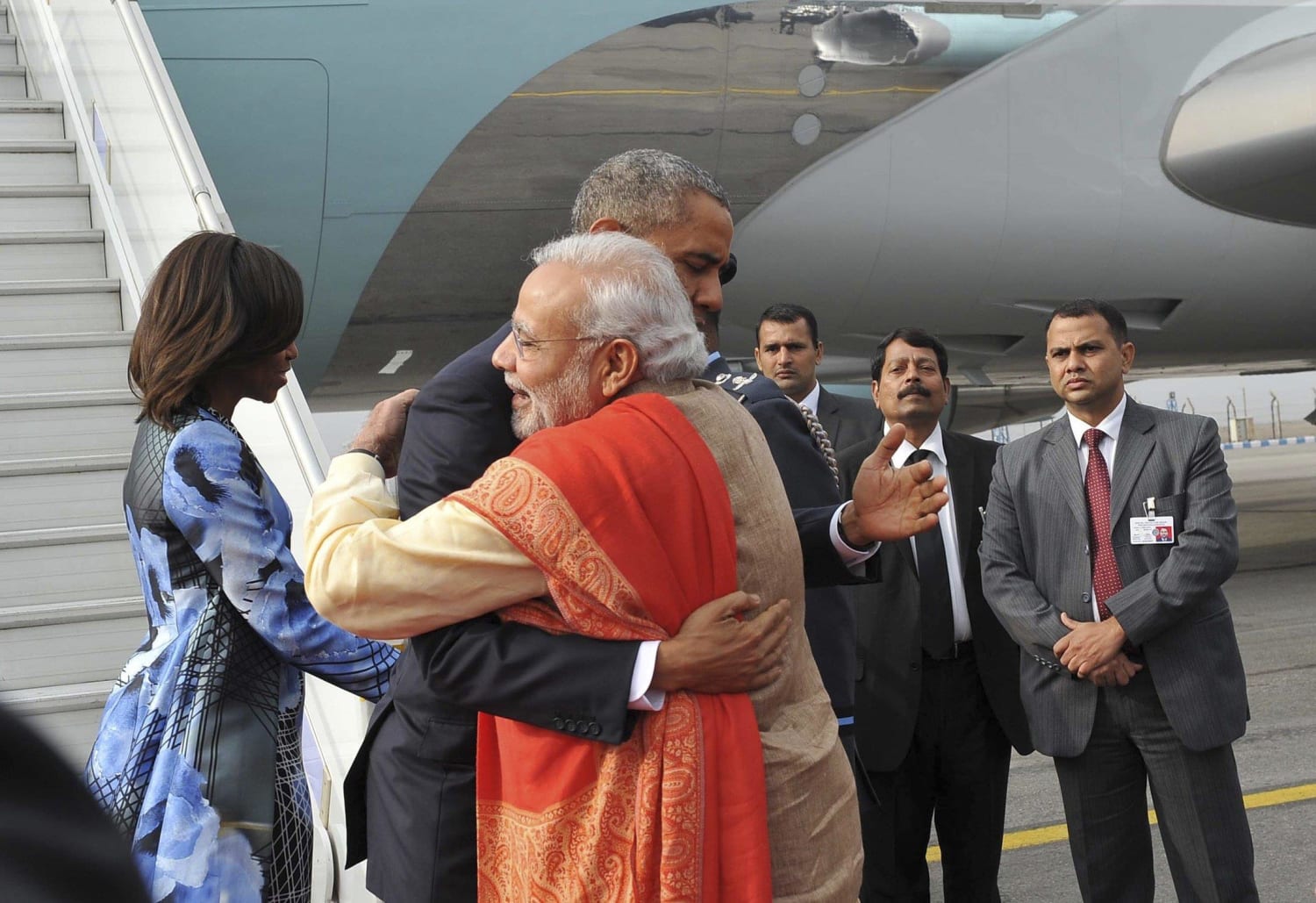
When POTUS meets LOTUS

"baahon ke darmiyaan, do pyaar mil rahe hain"

On this 66th Republic Day of India, a special friend and a prospective partner President Obama was the Chief Guest of the occasion. The whole ‘hullabaloo’ in the strategic relationship between India and US was vigorously circumscribed by this visit with breaking away of many old traditional protocols set up by the elitists of the two nations. The invitation scene was much more dramatic as it got sealed within 19 hours (literally) when the news broke out that the Russians have decided to sell Mi-35 helicopters to Pakistan (in November).

From all the ‘Twitter Bromance’ between Prime Minister Modi and President Obama - bro-hugs between them – ‘Chai Pe Charcha’ at Hyderabad House – Victory of Dress Designer of PM Modi over Michelle Obama’s designer – early departure of Prez Obama to a country where human rights are of supreme importance and where women are more loved and respected (Saudi Arabia), all clouded the ‘Breaking News’ column of the Indian as well as International Media (Barring Fox News for obvious reasons). But what were the substantial gains out of this high profile, orange candy visit?

If we go by media coverage (both Indian as well as International) the two leaders merely talked about Nuclear Deal only (for 3 full days) but that is something wrong in reality. Even though the logjams over the ‘Nuclear Liability Law’ have been cleared through the much needed political push from both the sides, but still it is commercially unviable for American companies to actually incorporate their nuclear plants in India. But the fact remains, that the bone has been ejected out of the throat, ironically by the surgeons who injected it earlier. Although full details of the deal are yet to come but precisely a pool of four insurance companies has been made that will indemnify Rs 750 crores in the case of an accident and the rest amount (said to be Rs 750 crores, total being Rs 1,500 crores) will be allocated by the Government of India. But it should not be forgotten that under the ‘Liability of Nuclear Damages Act, 2010’ (Section 7), there was a provision of creation of ‘Insurance Pool’ but that pool was of value of Rs 1,500 crores and any damage beyond that would be indemnified by the Government of India through another pool called ‘Nuclear Liability Fund’. There was a special ‘National Tracking Demand of Nuclear Material’ by the US officials that if they are providing us the nuclear material then they would like to keep a track on it ‘for lifetime’ to which India responded by saying that we are already following the provisions of IAEA so there is no particular need of this provision. Now, US seem to have agreed over this suggestion too. Skeptics say that it is immaterial if US has agreed over it because the Americans would keep tracking the same through their ‘own ways’, may be a reference to ‘software tracking’.

On the defence and strategic cooperation front, we managed to secure DTTI (Defence Technology and Trade Initiative). Actually it was the current Defence Secretary of US, Ashton Carter (pro-Israel and India) who prepared the framework of DTTI earlier, and as now he has been assigned to the high office, he would energetically push forward the same for its early implementation. Although in India, we have a perennial suspicion over assurance of defence supplies from US (as evident from the fact that we wasted the 10 year Defence Partnership Agreement from 2005-2015 without working on DTTI), but now the co-production model would overcome the reticence on India’s part. DTTI would help in enlarging our defence capacity, building our defence industry and will add up to the manufacturing sector of India.  Four modest projects have started, two aircraft carriers would be produced over the period of next 10-15 years in India and successively we would be helped in the manufacturing of jet engines for which India was eyeing towards a reliable partner since a long time. Still the fact remains that co-development of defence technology cannot have a sustained foundation unless there is a convergence of strategic and security perspectives because they build the much needed mutual trust. It doesn’t mean that we don’t have one with the US, as there are similar interests in Asia Pacific as well as in the Indian Ocean region.

On the issue of ‘Climate Change’ to which US is so much active these days that it points finger at ‘climate change’ for everything, even if it means a slight change in the skin colour of President Obama, the Prime Minister of India has rejected the notion that India would ever succumb to pressure from any country or a person over any issue (a reference to US-China bogus deal on climate change) but he didn’t forget to mention that climate change is a pressure itself for which India is doing enough at its own end by using renewable and clean sources of energy (nuclear energy, solar energy, wind energy etc). The onus also lies on America to give us IPR free ‘Green Technology’ to increase our proportion of clean energy in our total energy consumption.

When talks went on the ‘Totalization agreement’, US unambiguously said it only does ‘Totalization Agreements’ with OECD countries but India has pushed forward one on the pretext of having the same with Finland and Sweden because both these nations have recognized schemes like ULIP, PPF etc as ‘Social Security Schemes of India’ contrary to the belief of US which denies to recognize that India has social security schemes. Taxes for the ‘Social Security Schemes’ by Indians living in US (6-8.5%) contribute to about $ 3 billion (as per Chief Economic Advisor – Arvind Subramaniam) to US exchequer, even though most of the Indians do not take the benefits due to several reasons. Therefore, India was more willing to reach an agreement over this during this visit.

For the trade and business matters, there were usual assurances by India on ease of doing business, transparency and stability in policy, relaxation of taxation procedures as well as clamping down on retrospective taxation provisions but there was nothing US specific to which Prez Obama pledged $4 billion investment in renewable energy sector of India. He also didn’t forget to mention that India’s exports to US amount to merely 2% of total imports of US and imports by India amount to merely 1% of total US exports, which was certainly soothing for Chinese ears.

Chinese media (especially Global Times) started pinching Chinese Government over the ‘Special vision statement of strategic cooperation in Asia-Pacific and Indian Ocean region’ between India and US, clearly seen as a containment of China measure. It contains four major components – Freedom of navigation including in the South China Sea, building up of the trilateral dialogue along with Japan and identify trilateral projects (new component), avoiding the use of force in settling territorial disputes and a marriage of convenience between India’s Act East policy and the ‘Rebalancing policy’ of US towards whole Asia.

All in all, this was a successful visit as it cleared most of the broader issues except immigration reforms of US (but it is justified now because Democrats are in minority in Congress so it is not possible) and the transfer of technology in the field of science. But as the critics can never be satisfied, even if the two leaders would have smooched each other on live TV, so there is nothing wrong in moving at a prudent pace.

PS - That is how PM Modi actually welcomed Prez Obama. #SoSorry
https://www.youtube.com/watch?v=xnhxRcSH1zs

Thursday, 9 October 2014

'Kem Chho' Mr Prime Minister? - President Obama


One of the most anticipated visits of Prime Minister Narendra Modi was to the United States that ended up early this month. Anticipated one because this is the same US which denied him a visa earlier in 2005 for the alleged violation of human rights/minority rights for his 'alleged' role in 2002 Godhra riots. Now, the times have changed, the visa seeker CM Modi has turned out to be PM Modi in the run up to the world's biggest democratic elections ever.

Although Obama Administration was pre-occupied with internal as well as external issues, but they showed apparent interest in building new ties with India. It is because, the world has understood that PM Modi is a forceful personality, decisive, capable to take hard decisions and also business friendly. All these templates made it clear that Americans were very much looking forward to engage with the new powerful Prime Minister of India.

Prime Minister Narendra Modi went there with a tag of political as well as economic salesman, carrying brand India in his baggage to the far off the North-West Atlantic Ocean. Narendra Modi's departure statement carried 1/3rd mention to the meeting with President Obama, signaling other significant issues that would come on the table of negotiations during the bilateral talks.

The departure statement can be construed as the marking of start of Indian Renaissance era, and less of geostrategic angle to it. The visit of the United States was perfectly synchronized with the September 25th launch of 'Make In India' campaign to communicate that India is not merely a market now, and it is the upcoming hub of manufacturing. He further advocated his 'Make In India' vision to the US Business community by enlightening the importance of investing in India with the vision of 3D's - Democracy, Demography and Demand. In the strategic point of view, his statement clarified that India wants to be a bridge between the West and the East and at no circumstances, India would be pressurized to make a choice between the two. His article in the Wall Street Journal after his immediate arrival, made it clear that we are interested to re-energize the bilateral relation which was in a state of stagnation from the past few years. In the end, the efforts concluded with the relationship coming on track of incremental improvement with few small steps and big leaps.

The driving force behind the visit were two important issues -
  • First was the act of rebalancing visit of Chinese President in the same month of September.
  • Secondly, PM Modi is the new 'Head of the State', so there were a lot of contemplations regarding him in the West.
It was intended to be a transformational visit from the Indian side, and not from the US's side as Assistant Secretary of State for South Asia Nisha Biswal made it clear that US is not looking for a transformative action in this visit. But the Indian expectations of transformational visit didn't materialize in reality. To look at the visit in the context of deliverables, there was nothing substantial on the papers, but off the track, it spread the gospel that Modi era has begun and India will have effective governance, rule of law and predictability in the market, that the businessmen expect.

Liberals complained that major irritants were not discussed in detail like Solar equipment export to India on which US moved to WTO, IPR issues, Federal Aviation Authority of US downgrading Aviation Safety Ranking of India (DGCA), Federal Drug Administration clamping down on Indian pharmaceutical companies like Ranbaxy, Doha Round of Conference on Food subsidies (WTO FTA), impasse over the wrinkled Civil Nuclear Liability Act etc. Liberals also complained that India kept on adding task forces and working groups in this high profile visit too, which was not necessary as it could have been done at the bureaucratic level too and there was no need for a Head of the State visit for it.

Although, the visit should not be envisioned in the context of financial deliverables, but also to the intent that has been imparted through the momentum of forwarding the bilateral relationship. Both countries extended the Defense Cooperation Agreement for another 10 years, which was about to expire in 2015. US agreed for a comprehensive investment strategy in Indian infrastructure, especially building up 3 new smart cities at Ajmer, Allahabad and Vizag.

Joint statement by the head of states of both nations called for an agreement in near future that they will try to resolve the differences over the Civil Nuclear Liability law and America originated nuclear reactors will produce nuclear power in energy hungry India soon. Prime Minsiter Modi also made it clear that he is not against the Free Trade Agreement but he also wants to push his case in the WTO. President Obama looked towards increasing the bilateral trade from current $100 billion to $500 billion in the times to come.

Addressing the business community in US, PM Modi said, " I'm going to reform the policies and processes to make it easy to do business in India." These were the two major issues of US investors as they saw 'Policies' = Never meant to be reformed and 'Processes' = Bureaucratic red tapism. He also said, " You people can come to make money in India, we don't expect you to come and not make money, businesses are born to make money." Such a statement ran like a music to the ears of US investors as it was an out of the line statement by an Indian PM ever, indicating the pro-business image of the head of the Government of India.  But US investments would be guided by the time when Indian industry would start investing seriously and begins to place faith manifestly in Indian market.

The biggest task for which Prime Minister Narendra Modi took out a lot of time is to unite the Indo-American community and build it up as a powerful group to use them in the case of need for lobbying for national interest of India. It was inspired by the Jewish diaspora and their activities that gives legitimacy even to the illegitimate actions of Israel by the US.

Finally, the relationship has been reset at the highest level and the sourness of despair that was prevalent in the bilateral attitude has been neutralized up to some extent. Next few years, especially 2016, when the new President would be sworn in the US, would guide the future course of action. Till then, both India and US do realize the fact that they need each other at least for the next two decades to balance the strategic equations crossing each other's path and destiny.

Tuesday, 30 September 2014

A renewed U.S.-India partnership for the 21st century


Sharing a piece written by Prime Minister of India Narendra Modi and US President Barack Obama in The Washington Post, first of its kind initiative.

As nations committed to democracy, liberty, diversity and enterprise, India and the United States are bound by common values and mutual interests. We have each shaped the positive trajectory of human history, and through our joint efforts, our natural and unique partnership can help shape international security and peace for years to come.
Ties between the United States and India are rooted in the shared desire of our citizens for justice and equality. When Swami Vivekananda presented Hinduism as a world religion, he did so at the 1893 World’s Parliament of Religions in Chicago. When Martin Luther King Jr. sought to end discrimination and prejudice against African Americans, he was inspired by Mahatma Gandhi’s nonviolent teachings. Gandhiji himself drew upon the writings of Henry David Thoreau.
As nations, we’ve partnered over the decades to deliver progress to our people. The people of India remember the strong foundations of our cooperation. The food production increases of the Green Revolution and the Indian Institutes of Technology are among the many products of our collaboration.
Today our partnership is robust, reliable and enduring, and it is expanding. Our relationship involves more bilateral collaboration than ever before — not just at the federal level but also at the state and local levels, between our two militaries, private sectors and civil society. Indeed, so much has happened that, in 2000, then-Prime Minister Atal Bihari Vajpayee could declare that we are natural allies.
After many years of growing cooperation since, on any given day, our students work together on research projects, our scientists develop cutting-edge technology and senior officials consult closely on global issues. Our militaries conduct joint exercises in air, on land and at sea, and our space programs engage in unprecedented areas of cooperation, leading us from Earth to Mars. And in this partnership, the Indian American community has been a vibrant, living bridge between us. Its success has been the truest reflection of the vitality of our people, the value of America’s open society and the strength of what we can do when we join together.
Still, the true potential of our relationship has yet to be fully realized. The advent of a new government in India is a natural opportunity to broaden and deepen our relationship. With a reinvigorated level of ambition and greater confidence, we can go beyond modest and conventional goals. It is time to set a new agenda, one that realizes concrete benefits for our citizens.
This will be an agenda that enables us to find mutually rewarding ways to expand our collaboration in trade, investment and technology that harmonize with India’s ambitious development agenda, while sustaining the United States as the global engine of growth. When we meet today in Washington, we will discuss ways in which we can boost manufacturing and expand affordable renewable energy, while sustainably securing the future of our common environment.
We will discuss ways in which our businesses, scientists and governments can partner as India works to improve the quality, reliability and availability of basic services, especially for the poorest of citizens. In this, the United States stands ready to assist. An immediate area of concrete support is the "Clean India" campaign, where we will leverage private and civil society innovation, expertise and technology to improve sanitation and hygiene throughout India.
While our shared efforts will benefit our own people, our partnership aspires to be larger than merely the sum of its parts. As nations, as people, we aspire to a better future for all; one in which our strategic partnership also produces benefits for the world at large. While India benefits from the growth generated by U.S. investment and technical partnerships, the United States benefits from a stronger, more prosperous India. In turn, the region and the world benefit from the greater stability and security that our friendship creates. We remain committed to the larger effort to integrate South Asia and connect it with markets and people in Central and Southeast Asia.
As global partners, we are committed to enhancing our homeland security by sharing intelligence, through counterterrorism and law-enforcement cooperation, while we jointly work to maintain freedom of navigation and lawful commerce across the seas. Our health collaboration will help us tackle the toughest of challenges, whether combating the spread of Ebola, researching cancer cures or conquering diseases such as tuberculosis, malaria and dengue. And we intend to expand our recent tradition of working together to empower women, build capacity and improve food security in Afghanistan and Africa.
The exploration of space will continue to fire our imaginations and challenge us to raise our ambitions. That we both have satellites orbiting Mars tells its own story. The promise of a better tomorrow is not solely for Indians and Americans: It also beckons us to move forward together for a better world. This is the central premise of our defining partnership for the 21st century. Forward together we go — chalein saath saath.